
Notes from the recent presentations by David Einhorn, Louis-Vincent Gave and more
Some takeaways from the presentations at Skagen New Year's Conference 2025

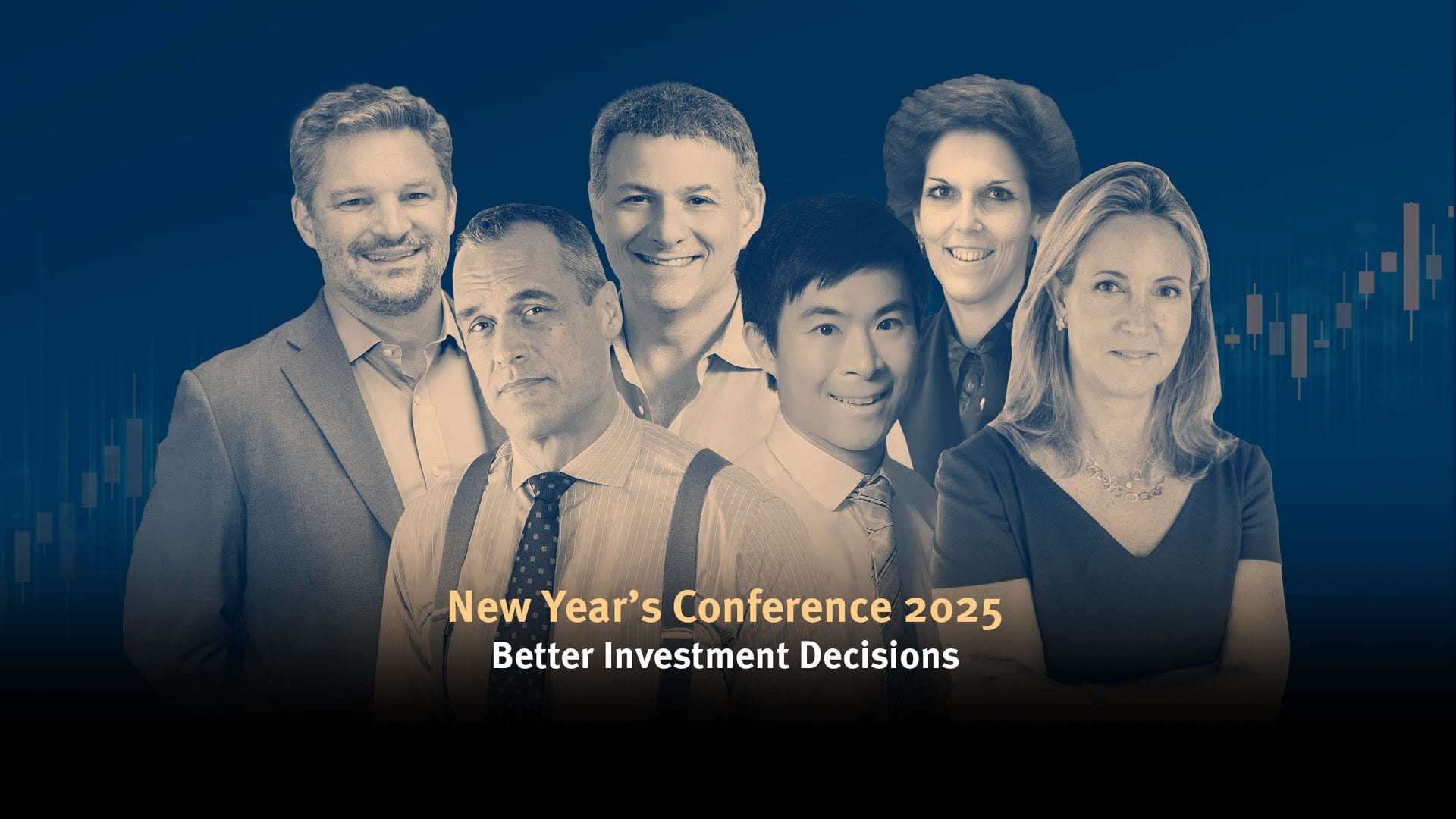
Just before the year end 2024, I noticed an invitation from SKAGEN Funds to their New Year's Conference 2025. I was sold directly when I saw that Louis-Vincent Gave would talk. In my opinion, he is THE expert to listen to when it comes to the geopolitics, Chine etc.
I was positively surprised when I saw the rest of the list over the speakers. The list includes David Einhorn (a legendary value investor), Dan Gardner (author of the book Superforecasters, that left a strong impression on me during my university studies), the former President & CEO Cleveland FED Loretta J. Mester (always interesting to get different perspectives on the same topic) and more.
I haven’t have time to listed to all the presentations, that you can find here. In the meantime, here are my notes from the four presentations that I did listen to.
David Einhorn
About the market development 2025: The market is difficult to predict, but prices are high, there are signs of inflation bottoming out, and uncertainty has increased, e.g., political changes.
On Lehman: He shorted Lehman Brothers before the bank went bankrupt in 2008. According to David Einhorn, there were many companies exposed to the same problems, but Lehman had the biggest exposure at the same time as they denied potential problems the most. He counted with a different outcome though and recognizes an element of luck.
What is "Value"? David Einhorn defines value as buying something for less what it is worth. Growth is not an opposite but rather a component of value.
One can't be certain of anything in investing, why some diversification is always needed.
His biggest mistakes came when trying to change things via an active involvement in the company management (didn't work) and investing in a company that turned out to be fraud despite the many "flags" that could be seen before the investment.
Value traps can remain value traps for a long time if there is no change in fundamentals. Hence, he prefers investing in stocks where one can reasonably see double digit cash returns via dividends / buybacks. In other words, he searches for companies that pay back money to investors rather than relying on the stocks being rerated.
The market structure and pricing mechanisms are broken due to the passive flows and not many care about the underlying value anymore. This means that undervalued can become more undervalued and overvalued can become more overvalued.
He is worried about the stocks, where a high growth for a long time is needed to justrify the valuation. A small change in expectations can lead to huge losses.
Investing is not only a mathematical exercise but rather a puzzle with many clues to be sold.
People with bad incentives tend to do bad things and vice versa.
He believes that the war in Ukraine is likely to end soon which could be bullish for European industrial companies with the exception for the auto industry.
One shouldn't undersestimate the signal value of Buffet's cash position..
Louis-Vincent Gave
Lous-Vincent Gave always has a non-conventional view on geopolitics and China, compared to the conventional media and it is always worthwile listening to him.
The year 2024 was full of surprises and anomalies, especially the ending, that includes crypto markets doubling, Tesla gaining almost $ 1trn in market cap, unusually weak performance of the small caps compared to the large caps etc.
In this presentation, he talked about how media has been painting a picture of China's economy collapsing. He shows that this view is biased, partly wrong and there are explanations for that.
Real estate is doing poorly, but that is only one part of the economy and it doesn't have that much impact on the rest of the world. What has more impact is the technological leadership that China is gaining in diverse areas.
In 2018, diverse trade constraints were introduced regarding technology exports from West to China. This incentivized the Chinese government towards more self-sufficiency and becoming leading in selected industries. Electric vehicles is one example, where China has become the largest car exporter in just a few years. We can see the implications of that in Germany..
Many miss that Chinese equities did actually increase by almost >25% in 2024 and that many of the economic metrics point up. The trade surplus has become huge and there has been much focus on making the currency stable.
Another interesting thing is that China is now borrowing at below 2% compared to the US with a bond-yield of almost 5%..
Donald Trump and his administration could mean changes. Louis-Vincent Gave notes, that there have been diverse negative comments aimed towards Europe, Canada etc. What hasn't been talked much about is China. Quite the opposite. Xi Jinping is invited to the inauguration while the soon-to-be US Treasury Secretary Scott Bessent has given signs of being keen to strike a deal with China..
Loretta J. Mester - Former President & CEO Cleveland FED
The US economy was doing well before the pandemic. Inflation was close to the targeted 2% and unemployment was low. Then everything became chaotic with the pandemic, war in Ukraine, supply chain constraints etc.
She admits that the FED was very stimulative during the pandemic, but was late to start increasing rates when the economy turned out to develop well.
The current situation looks stable but she sees more risks for inlation increasing than the opposite which would indicate that the FED shouldn't hurry to cut the interest rates.
One of the risks for a higher inflation is the new US President Donald Trump. However, one must wait and see what actually happens because talk is talk.
I liked the question about fixation on the 2% inflation target, to which Loretta J. Mester couldn't give any clear answer, beside that reaching the target means creditibility and it is a number that other central banks use.
Dan Gardner
Dan Gardner co-wrote a book called Superforecasters that I read during my university studies a long time ago. The presentation was about the topic of forecasting and decision making.
The main idea is to always break down the problem into smaller peaces. This helps you to break out of the instinct of using the intuition and critically assess the intuitive assumptions.
Another recommendation is to do a "Pre-Mortem". This means, that instead of trying to critically assess the decisions and risks one should start with an assumption that the idea already has failed. Then the analysis becomes - what lead to the failure? '
To sum it up, we live in an uncertain world (the one thing that never changes..). Anyway, thankful to SKAGEN for making these presentations available!